Anatomy & Function
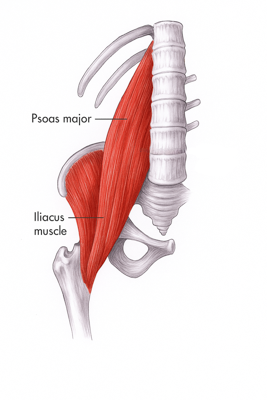
The iliopsoas is a complex of two muscles: the psoas major and the iliacus. They are the primary hip flexors, lifting the leg to walk or run. But more importantly, the psoas attaches directly to the lumbar spine discs and vertebrae.
Because of this attachment, the psoas acts as a massive stabilizer. When it contracts, it compresses the lumbar discs and joints. In a healthy back, this provides stability. In an injured back, it can become a source of crushing pressure.
The Injury Mechanism
In a motor vehicle accident, especially one involving rapid deceleration (like hitting the brakes before impact), the body reacts in a sequence:
The body is thrown forward while the lower body is fixed by the seatbelt and floorboard.
The psoas contracts explosively to "catch" the spine and prevent hyperextension.
The muscle locks into spasm, pulling vertebrae forward and down, compressing discs and jamming facet joints long after the crash.
Pain Patterns
Psoas pain is tricky because it rarely hurts in the abdomen where the muscle lives. Instead, it refers to three main zones:
Vertical Low Back Pain
A deep ache running up and down along the spine (paraspinal area).
Groin Pain
A deep ache in the front of the hip or groin crease.
Front of Thigh
A vague ache or burning sensation traveling down the quadriceps.
Common Symptom: Difficulty standing up straight after sitting. Patients often feel they have to "unfold" their hips before walking comfortably.
Treatment Approach
Treating the psoas requires a specific approach because it is deep inside the abdomen, behind the organs.
1. Manual Release
Skilled manual therapy accesses the psoas through the abdomen. This is often uncomfortable but can provide immediate initial relief if the muscle releases.
2. Lengthening & Strengthening
Once the spasm releases, we focus on lengthening the hip flexors and strengthening the glutes (the opposing muscle group) to maintain the new, healthy alignment.
3. Hydrostatic IMS
For stubborn cases, we use Hydrostatic IMS. We place a fine needle into the muscle belly and introduce sterile saline. The hydrostatic pressure gently expands tight muscle fibers, forcing them to release their grip on the spine.
Summary: The psoas is a hidden driver of low back pain. Its spasm compresses the spine and mimics disc pain. Releasing it requires targeted, deep work, but unlocking this muscle is often the key to resolving chronic low back pain after an accident.